Silence as a Strategy: How American Classrooms Inadvertently Train Students to Stop Asking Questions
The Question That Wasn't Welcome
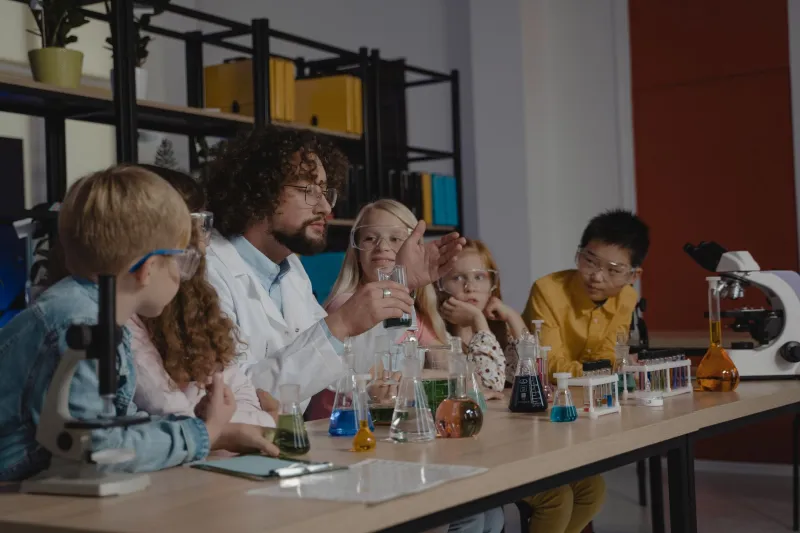
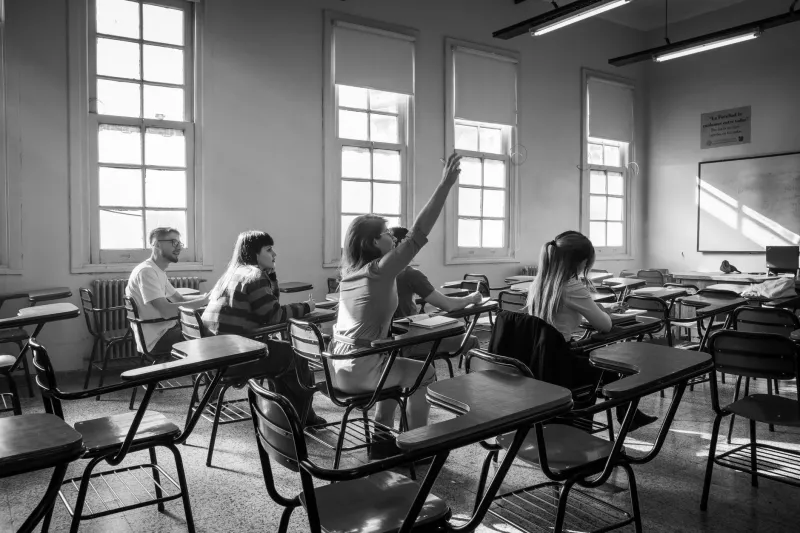
In a high school chemistry classroom in Ohio, a student raised her hand midway through a unit on atomic theory and asked why the Bohr model, which the class had spent two weeks studying, was still being taught if physicists had known for decades that it was a significant simplification of actual atomic structure. Her teacher, caught off guard, told her the question was interesting but that they needed to stay on schedule. The student was not reprimanded. She was simply redirected. She did not ask another question of that kind for the remainder of the semester.
This is not an unusual story. Versions of it occur in classrooms from elementary school through undergraduate education, and the mechanism is rarely as blunt as a reprimand. It operates through subtler signals: the slightly too-long pause before a teacher responds to a challenging question, the tone that marks a question as inconvenient rather than illuminating, the assessment structure that rewards accurate recall and penalizes the kind of productive uncertainty that serious inquiry requires. Over time, students read these signals accurately. They learn what kind of intellectual behavior the classroom rewards, and they adjust accordingly.
The result is a population of students who have been trained, not by explicit instruction but by accumulated experience, to perform understanding rather than develop it.
How Assessment Systems Shape Intellectual Behavior
The relationship between assessment design and intellectual behavior is well established in educational research, though its implications are not always followed to their logical conclusions. When assessments consistently reward the accurate reproduction of information — the correct answer to a factual question, the expected result in a laboratory exercise, the standard interpretation of a data set — students learn to optimize for accurate reproduction. This is not a failure of character. It is a rational response to the incentive structure they inhabit.
The problem is that accurate reproduction is not the same as understanding, and it is not remotely the same as scientific thinking. Scientific thinking, in any serious sense of the term, requires the capacity to hold conclusions provisionally — to recognize that current knowledge is the best available approximation rather than a finished product, and that the appropriate response to new evidence is to revise one's model rather than defend the prior answer.
Students who have been trained by assessment systems to defend the prior answer are not developing that capacity. They are developing something that looks like it from the outside — confident, fluent, high-scoring — but that collapses when it encounters genuinely novel problems, ambiguous data, or findings that contradict what they were told to learn.
The student who asks why the Bohr model is still being taught is demonstrating exactly the kind of thinking that scientific education should cultivate. She has recognized a gap between what the curriculum presents and what the broader body of knowledge suggests. She is doing, in an informal and unpolished way, what scientists do when they encounter an anomaly. The classroom's response to her question — not hostile, but quietly discouraging — is a small but concrete act of intellectual suppression.
The Teacher's Dilemma
It would be unfair to locate the problem primarily with individual teachers, most of whom entered the profession with genuine commitment to student learning. The constraints they operate under are real and significant. Curriculum coverage requirements, standardized testing schedules, class sizes, and administrative expectations about orderly progression through material all create pressure to move forward rather than linger on questions that complicate the lesson's trajectory.
A student who asks a genuinely searching question about the assumptions underlying a standard scientific model is not asking a question that can be answered in three minutes and set aside. She is opening a line of inquiry that, pursued honestly, might take a full class period — or several. In a schedule already compressed by coverage requirements, that is not a small ask. The teacher who redirects her is not necessarily incurious. She may simply be operating within a system that has not made space for the kind of conversation the student is trying to initiate.
Teacher preparation programs bear some responsibility here as well. Instruction in how to facilitate productive intellectual disagreement, how to distinguish between a student who is genuinely confused and one who is thinking carefully, and how to use a challenging question as a teaching opportunity rather than a scheduling problem — these are not uniformly present in teacher education curricula. The capacity to welcome productive doubt requires specific pedagogical skills, and those skills need to be developed deliberately.
Productive Doubt Versus Off-Task Behavior
A legitimate concern in any discussion of student questioning is the distinction between genuine intellectual inquiry and behavior that is disruptive, off-task, or designed to derail instruction rather than advance it. These are not the same thing, and conflating them does a disservice to both teachers and students.
Researchers in science education have developed frameworks for making this distinction operational. Productive inquiry tends to be specific — it references particular claims, methods, or findings and asks about their basis or limitations. It is oriented toward understanding rather than toward undermining the authority of the teacher or the subject. It can be redirected into an investigation: a student who questions a standard result can be invited to design a test of that result, or to research the history of how the current understanding was established.
Off-task behavior, by contrast, tends to be general and dismissive rather than specific and engaged. It resists rather than interrogates. The distinction is not always easy to draw in real time, and teachers who must make it dozens of times a day deserve practical tools rather than abstract principles. But the existence of genuinely difficult cases does not justify treating all challenging questions as suspect.
What Inquiry-Centered Classrooms Actually Look Like
A growing body of practice — documented in schools from Massachusetts to California — demonstrates that classrooms can be structured to reward productive doubt without sacrificing coherence or coverage. The key features of these environments are worth examining in some detail.
In inquiry-centered classrooms, questions are treated as data. When a student asks why a standard model is used rather than a more accurate one, or what assumptions underlie a measurement technique, the teacher's first response is not to answer but to ask the class what they think — and to make the student's question visible as a legitimate scientific concern rather than a scheduling inconvenience. The question becomes part of the lesson rather than an interruption of it.
Assessment in these environments includes explicit evaluation of reasoning quality, not only answer accuracy. Students are asked to justify their conclusions, identify the limitations of their evidence, and propose alternative interpretations of data. A student who reaches a wrong conclusion through careful reasoning receives different feedback than one who reaches the right conclusion through rote recall — and both receive feedback that advances their thinking rather than simply confirming or denying their answer.
These are not exotic practices. They are consistent with the scientific practices embedded in the Next Generation Science Standards and with decades of research on how students develop durable scientific understanding. The barrier to their adoption is not primarily pedagogical ignorance. It is the assessment and accountability infrastructure that continues to measure student performance in ways that reward the behaviors inquiry-centered teaching is designed to replace.
The Cost of Trained Silence
The student who stopped asking questions after her inquiry about the Bohr model did not stop thinking. She learned, instead, to keep her thinking to herself — to perform the expected intellectual behavior while reserving genuine curiosity for contexts outside school. This is an outcome that no educator would endorse in principle. It is an outcome that many classroom systems produce in practice.
The scientific community requires, at its foundation, researchers who are capable of questioning accepted frameworks. That capacity does not emerge spontaneously at the graduate level in people who spent twelve years learning that questions are inconvenient. It is cultivated, or it is suppressed, beginning in the earliest years of formal education. The choice about which outcome to pursue is made not in a single policy decision but in thousands of small moments — the pause before a teacher responds, the design of the next assessment, the question that gets welcomed and the one that gets redirected. Those moments accumulate into a culture, and cultures shape minds.